

Business Reporting: From Data to Decisions for Growth
Drowning in data but starving for insights? This guide explains why proper business reporting is the key to transforming raw numbers into a clear roadmap for sustainable growth and confident decision-making.
From Data to Decisions: Why Proper Business Reporting Is Crucial for Growth
In today's competitive landscape, businesses are flooded with information. Every click, sale, and customer interaction generates a new piece of information. Yet, many business owners find themselves drowning in this ocean of information, unable to find the clarity needed to steer their company toward sustainable growth. This isn't just a minor inconvenience; it's a critical operational failure that leads to wasted resources, missed opportunities, and reactive, gut-feel decisions that stifle progress.
The solution lies in effective business reporting. It's the bridge that connects raw, chaotic information to clear, actionable insights. At Upsurge Pros, we've seen firsthand how implementing automated reporting systems transforms a business. By creating a single source of truth, you move from wondering what happened last quarter to knowing what's happening right now, empowering your team to make strategic decisions with confidence. This guide will demystify the process, showing you why reporting is non-negotiable for any business serious about growth.
What Is Business Reporting?
Business reporting is the process of collecting, organizing, and presenting business information to monitor performance and inform decision-making. It transforms raw operational details from various departments—like sales, marketing, and finance—into digestible formats such as visual summaries, charts, and simple breakdowns to provide insights into a company's health and trajectory.
Why Do Small Businesses Often Ignore Reporting?
Many small businesses ignore formal reporting because of a perceived lack of time, resources, and expertise. Leaders are often consumed by daily operations and believe their intuitive understanding of the business is sufficient, delaying the implementation of structured information tracking.
This tendency is rooted in the "founder's hustle" mentality. When a business is small, the owner is involved in every transaction and conversation. They have a strong gut feeling for what's working and what isn't. However, this approach doesn't scale. As the team grows and customer volume increases, that intuitive sense becomes less reliable. The owner can no longer be everywhere at once, and critical details start to slip through the cracks.
Another common barrier is technical intimidation. The idea of setting up a business reporting dashboard, integrating a customer relationship management system, or defining key performance indicators can seem overwhelming. Many business owners believe it requires a dedicated information analyst or expensive software, so they stick with familiar but inefficient tools like scattered spreadsheets. This creates a cycle where the lack of a system makes the information feel more chaotic, which reinforces the belief that implementing a proper system is too complex. They ultimately choose the path of least resistance, not realizing the significant hidden costs of this inaction.
- The "Too Busy" Fallacy: Owners believe they're too busy fighting fires to build a fire alarm system. They prioritize urgent tasks over the important work of building scalable systems.
- Fear of the Unknown: Some leaders subconsciously avoid information because they are afraid of what it might reveal about their strategies, team performance, or overall business health.
- Over-reliance on Instinct: Early successes built on gut feel can create a false sense of security, leading to a belief that information is for larger corporations, not them.
- Perceived Cost and Complexity: The assumption that proper business analytics for small business requires a massive budget and a team of experts prevents many from even exploring modern, affordable solutions.
What Happens When Businesses Don’t Track Their Information?
When businesses fail to track their information, they operate in a reactive state, making critical decisions based on assumptions and anecdotes. This leads to misallocated budgets, unidentified operational leaks, declining profitability, and a complete inability to forecast future performance accurately.
Imagine a marketing team spending thousands on a social media campaign because it "feels" like it's generating buzz. Without proper business information reporting, they can't see that the campaign is driving low-quality leads that never convert. The sales team, meanwhile, is frustrated by the poor lead quality but can't prove it with numbers. Resources are wasted, morale drops, and a key growth opportunity is missed. This isn't a hypothetical; it's a daily reality for companies without a single source of truth.
Without information, problems remain hidden until they become crises. A slow decline in customer satisfaction goes unnoticed until negative reviews pile up. A profitable product line's margins slowly erode due to rising costs, but no one notices until the quarterly Profit and Loss statement shows a surprising loss. You become a passenger in your own business, reacting to events rather than directing them. In contrast, businesses that embrace reporting can spot these trends early and intervene proactively, turning potential disasters into strategic adjustments.
| Aspect | Business Without Reporting | Business With Reporting |
|---|---|---|
| Decision Making | Based on gut feel, anecdotes, and loudest opinions. | Based on objective information, trends, and proven facts. |
| Resource Allocation | Budget spent on what "seems" to be working. | Budget allocated to highest ROI channels and activities. |
| Problem Solving | Reactive. Fixes problems after they cause damage. | Proactive. Identifies negative trends before they become crises. |
| Growth Strategy | Haphazard and opportunistic. | Strategic and scalable, based on predictable models. |
What Are the Most Important Reports Every Business Should Track?
Every business should track a core set of reports across finance, sales, and marketing to maintain a holistic view of performance. These include financial health statements (Profit and Loss, Cash Flow), sales pipeline and conversion rates, and marketing effectiveness metrics like Customer Acquisition Cost and Return on Ad Spend.
While the specific key performance indicators may vary by industry, a universal truth is that you cannot manage what you do not measure. A balanced reporting structure acts as your business's instrument panel, providing real-time feedback on its vital signs. Without it, you are flying blind. Begin with the foundational reports that directly impact profitability and cash flow, as they are the lifeblood of any organization.
From there, expand into departmental performance. For sales, effective CRM reporting is not just optional; it's essential. It reveals your sales cycle length, conversion rates at each stage, and top performer activities. In marketing, you must move beyond superficial metrics like 'likes' and focus on numbers that tie directly to revenue: Customer Acquisition Cost (CPA), Lifetime Value (LTV), and Return on Ad Spend (ROAS). Combining these departmental reports gives you a full-funnel view, from the first marketing touchpoint to the final sale and beyond, which is the core of effective business performance reporting.
Essential Business Reports Checklist
- Financial Reports:
- ☐ Profit & Loss (P&L) Statement
- ☐ Cash Flow Statement
- ☐ Balance Sheet
- ☐ Accounts Receivable/Payable Aging
- Sales Reports:
- ☐ Sales Pipeline by Stage
- ☐ Lead-to-Close Conversion Rate
- ☐ Sales Cycle Length
- ☐ Sales by Representative/Region
- Marketing Reports:
- ☐ Customer Acquisition Cost (CPA)
- ☐ Return on Ad Spend (ROAS)
- ☐ Website Traffic and Conversion Rate
- ☐ Lead Source Performance
- Operational Reports:
- ☐ Customer Satisfaction (CSAT/NPS)
- ☐ Customer Churn Rate
- ☐ Employee Productivity/Utilization
How Does Reporting Improve Decision-Making?
Reporting improves decision-making by replacing subjective guesswork with objective, verifiable facts. It allows leaders to identify patterns, validate hypotheses, and allocate capital and effort to initiatives with the highest probability of success, drastically reducing risk and accelerating growth.
The fundamental shift is from being reactive to proactive. Instead of making a decision and hoping for the best, you analyze information to inform the decision from the outset. For example, a report might show that leads from LinkedIn ads convert at a 10% rate, while leads from Google Ads convert at 3%. A decision based on gut feel might be to "do more marketing." A decision based on reporting is to double down on the LinkedIn ad budget and investigate why the Google Ads are underperforming.
This information-driven approach creates a virtuous cycle of improvement. Each decision is a test, and the subsequent reports provide the results. This feedback loop allows you to systematically optimize every aspect of your business, from your sales process to your product features. It removes emotion and office politics from strategic conversations. When the information is clear, the path forward becomes obvious, aligning the entire team around a common goal supported by facts, not opinions. This is the essence of building a truly intelligent organization.
- Identify a Question: It starts with a strategic question, such as "Which of our services is most profitable?"
- Gather Relevant Information: An objective report is generated, pulling in revenue and cost details associated with each service line.
- Discover an Insight: The report reveals that Service A has the highest revenue but the lowest margin, while Service C has lower revenue but a 70% margin.
- Make a Data-Informed Decision: The leadership team decides to create a new marketing campaign focused exclusively on promoting the high-margin Service C.
- Measure the Outcome: New reports track the campaign's success, showing an increase in overall company profitability even if top-line revenue growth is slower.
Why Manual Reporting Doesn’t Work Anymore
Manual reporting is obsolete because it is dangerously slow, highly susceptible to human error, and completely unscalable. It drains hundreds of valuable employee hours on low-value detailed entry, creating outdated reports that reflect the past instead of informing the present.
Consider the typical manual process: an employee spends hours every week exporting information from a customer relationship manager, a payment processor, and a marketing platform. They painstakingly copy and paste this information into a massive master spreadsheet. A single misplaced decimal or a broken formula can corrupt the entire report, leading to disastrously wrong conclusions. By the time the report is finally compiled, reviewed, and distributed, the information is already a week old—a lifetime in a fast-moving market.
This process does more than just waste time; it kills agility. When a key stakeholder asks a follow-up question, the response isn't immediate. Instead, it's "I'll have to rerun the numbers and get back to you." This delay breaks the flow of strategic thinking and prevents real-time course correction. Furthermore, it's a significant drain on morale. Talented employees are reduced to information janitors instead of contributing their analytical skills. In a world where automated systems can provide instant, accurate insights, clinging to manual reporting is a form of self-imposed handicap.
The Hidden Costs of Manual Reporting
- High Risk of Error: Manual information transfer and formula management are breeding grounds for mistakes that can lead to costly bad decisions.
- Significant Time Sink: Countless hours are spent on repetitive compilation tasks instead of analysis, strategy, and execution.
- Information Silos: Information remains trapped in different departments and spreadsheets, making a holistic view of the business impossible.
- Lack of Real-Time Insight: Reports are outdated the moment they are created, making proactive management impossible.
- Scalability Ceiling: As information volume grows, the manual process breaks down completely, leading to either guesswork or operational paralysis.
How Automation Changes Business Reporting
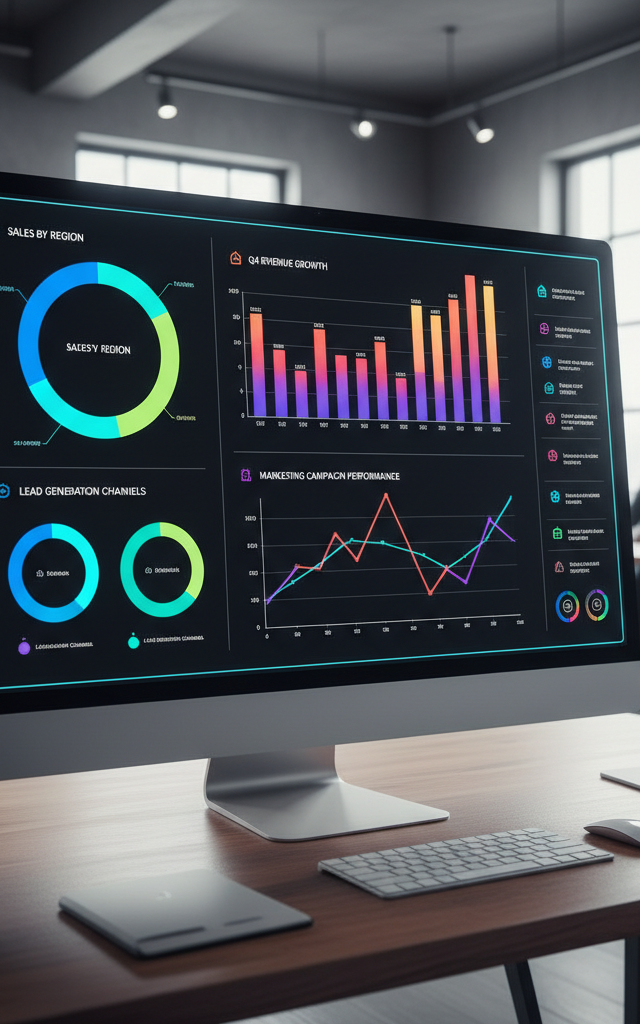
Automation revolutionizes business reporting by creating a live, unified, and error-free view of performance. Automated reporting systems connect directly to all information sources—customer relationship management, finance, operations—to present real-time information in a central, accessible dashboard.
This is the definitive solution to the problems of manual reporting. Instead of an employee spending a day compiling information, an automated system does it every second of every day. It eliminates human error from the information-gathering process entirely. This shift has a profound impact: it moves the focus from *information collection* to *information interpretation*. Your team is no longer bogged down asking "What happened?". Instead, they can immediately start asking the more valuable questions: "Why did this happen?" and "What should we do next?"
Modern business intelligence for small business is no longer a luxury. Cloud-based tools can integrate your various platforms into a single dashboard that tells a coherent story about your business. For example, you can see in real-time how a marketing campaign's ad spend is influencing website traffic, which in turn affects lead generation in your customer relationship management system, and how that translates to your sales pipeline and, ultimately, your bank account. This connected view, provided by automated reporting systems, is the key to unlocking true operational agility and a competitive advantage.
| Feature | Manual Reporting | Automated Reporting |
|---|---|---|
| Information Freshness | Weekly or Monthly (Outdated) | Real-Time (Live) |
| Accuracy | Prone to human error | Highly accurate and consistent |
| Time Required | Hours or Days | Instant / Automatic |
| Accessibility | Static files (spreadsheets, PDFs) | Interactive, web-based summaries |
| Focus | Information Collection | Strategic Analysis |
Why We Are Leaders in Business Reporting Clarity
At Upsurge Pros, we operate on a simple but powerful principle: most businesses don’t lack information; they lack clarity. Our expertise lies not just in pulling information, but in transforming it into a coherent narrative that drives intelligent action. We specialize in building the bridges between disparate systems—your customer relationship management, marketing platforms, financial software, and operational tools—to create a single, unified source of truth.
Our experience spans hundreds of deployments for businesses of all sizes. We've seen firsthand how an e-commerce company doubled its profitability by finally connecting ad spend to customer lifetime value, or how a business-to-business service firm optimized its sales process by visualizing its pipeline velocity. This work has given us a unique perspective on which metrics truly matter and which are just noise. We don't just provide a dashboard; we provide a framework for thinking about your business more intelligently.
Our specialization is in turning these integrated feeds into automated reporting systems that are intuitive and actionable. We focus on designing summaries that answer the most critical business questions at a glance, freeing leadership teams from the drudgery of information wrangling so they can focus on what they do best: leading and growing the business. We deliver clarity from chaos, turning your information from a liability into your most valuable strategic asset.
How Businesses Use Automated Reporting Today
- E-commerce Stores use live visual summaries to monitor cart abandonment rates and immediately trigger recovery email sequences, recapturing lost revenue.
- SaaS Companies track monthly recurring revenue (MRR), churn rate, and customer lifetime value (LTV) by group to make informed decisions on pricing and feature development.
- Marketing Agencies provide clients with real-time visual summaries showing campaign Return On Investment, proving their value and facilitating strategic pivots without delay.
- Logistics Companies analyze delivery times, fuel costs, and route efficiency to identify cost-saving opportunities and improve service levels.
- B2B Sales Teams leverage CRM reporting to track pipeline velocity, identify bottlenecks in the sales process, and forecast quarterly revenue with higher accuracy.
- Retail Businesses correlate foot traffic information with point-of-sale details to optimize staffing levels and product placement for peak hours.
- Service-Based Businesses track project profitability and employee utilization rates to ensure that both clients and projects are profitable and that workloads are balanced.
Frequently Asked Questions About Business Reporting
What is the difference between reporting and analytics?
Reporting organizes information to summarize what happened, focusing on monitoring performance against goals. Analytics interprets that information to discover why it happened and to predict what will happen next, focusing on uncovering insights and guiding strategy.
How often should a small business review its reports?
Key operational metrics, like sales or website traffic, should be monitored daily or weekly via a visual summary. Deeper financial and strategic reports, like a Profit & Loss statement, should be reviewed on a monthly and quarterly basis to assess overall business health and trajectory.
What is the first step to setting up a business reporting system?
The first step is to define your single most important business question (e.g., "Where do our most profitable customers come from?"). This focuses your efforts on tracking the few key metrics (KPIs) that will answer that question, preventing you from getting lost in irrelevant information.
What is a KPI in business reporting?
A KPI, or Key Performance Indicator, is a specific, measurable value that demonstrates how effectively a company is achieving key business objectives. Examples include Customer Acquisition Cost (CAC), Monthly Recurring Revenue (MRR), or Sales Conversion Rate.
Is Excel good enough for business reporting?
Excel can be a starting point, but it's not a scalable solution for modern business reporting. It's manual, error-prone, lacks real-time capabilities, and can't easily integrate with multiple information sources like dedicated automated reporting systems can.
What is CRM reporting?
CRM reporting involves analyzing the information held within your Customer Relationship Management (CRM) software. It provides critical insights into your sales pipeline, team activities, customer interactions, and overall sales performance, helping you optimize your entire sales process.
Conclusion: Your Information Is a Roadmap, Not a Rearview Mirror
Ultimately, effective business reporting is about looking forward, not just back. It transforms information from a confusing record of past events into a clear roadmap for future growth. By moving away from manual spreadsheets and gut-feel decisions toward a unified, automated system, you equip your organization with the clarity and agility needed to thrive in any market. The goal isn't to collect more information, but to make more confident, intelligent, and profitable decisions.
This transition from information chaos to strategic clarity empowers every member of your team to understand their impact on the bottom line. It fosters a culture of accountability and continuous improvement, driven by facts, not fiction. The most successful businesses don't just have information; they have a system for turning that information into decisive action. Your first step is to identify the one key metric that, if improved, would have the greatest impact on your business.
Related Articles

Ready to Transform Your Business?
Let's discuss how AI-powered automation can help you generate more leads and grow your business.
Book Your Free Strategy Call