
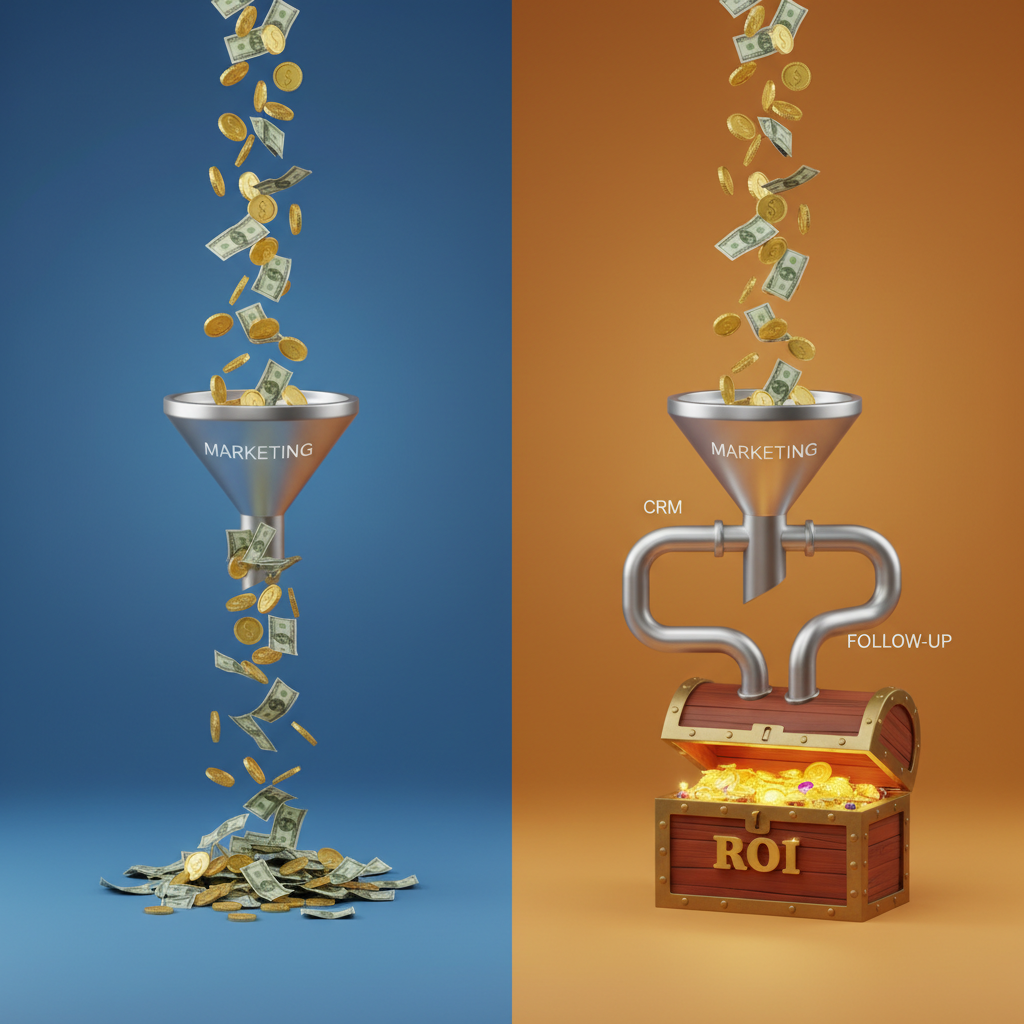
Marketing and Lead Generation Without Follow-Up Wastes Money | How to Fix It
Discover why acquiring marketing leads without a proper follow-up process is a major financial drain. This guide provides a step-by-step framework for fixing the leak in your sales funnel using CRM and automation.
Marketing and Lead Generation Without Follow-Up Is a Waste of Money (Here’s How to Fix It)
You've invested heavily in marketing—running ads, creating content, and optimizing your website to attract potential customers. The leads are flowing in, but your revenue isn't growing at the same pace. This disconnect is one of the most common and costly problems in business: a failure to systematically follow up with the marketing leads you worked so hard to acquire.
In an economy with rising customer acquisition costs, letting a qualified lead go cold is like throwing your marketing budget directly into a shredder. As a firm that specializes in building both high-performance marketing campaigns and the custom CRM systems to manage them, we've seen this costly mistake cripple growth for countless companies. The solution isn't just to 'try harder'; it's to build a deliberate, technology-driven system. This guide will show you precisely why marketing without follow-up is a waste of money and provide a clear framework to fix it, ensuring every dollar you spend on marketing has the best possible chance of generating a return.
Why Is Marketing Without Follow-Up a Waste of Money?
It's a waste because you pay the full price to capture a prospect's interest but fail to capitalize on the opportunity, generating zero return on that investment. Without prompt engagement, leads quickly forget your brand, lose interest, and ultimately purchase from a competitor who does follow up effectively.
The cost of acquiring a lead (Cost Per Lead or CPL) is a direct marketing expense. Whether it comes from a Google Ad click, a social media campaign, or a trade show, you've paid for that person's attention. When that lead is ignored, the money spent is sunk with no potential for recovery. This isn't just a missed sale; it's a quantifiable marketing loss. Studies consistently show that the majority of sales-ready leads are not converted simply due to a lack of nurturing. You are essentially funding your competitors' sales pipelines by warming up leads and then abandoning them.
Furthermore, this neglect damages your brand reputation. A prospect who takes the time to show interest—downloading a guide or requesting a demo—and receives silence in return perceives your company as disorganized and unresponsive. They are highly unlikely to engage with your brand again in the future. The initial investment is not only wasted, but you have also created a negative brand association that can hurt future marketing efforts.
The Financial Impact: With vs. Without Follow-Up
| Metric | Without Follow-Up System | With Follow-Up System |
|---|---|---|
| Marketing ROI | Negative or Near-Zero | Positive and Measurable |
| Lead-to-Customer Rate | <1% | 5-20% or higher, depending on industry |
| Sales Cycle Length | Infinite (no close) | Defined and Optimized |
| Brand Perception | Unprofessional, Unresponsive | Attentive, Professional, Helpful |
How Quickly Do Uncontacted Leads Lose Value?
Uncontacted marketing leads lose the majority of their value within the first 60 minutes. The odds of making successful contact with a lead are over 100 times higher if you respond in the first 5 minutes compared to just 30 minutes later, making speed the single most critical factor in lead conversion.
This phenomenon is known as 'lead decay'. The moment a person submits a form, they are in a peak state of interest. Your product or solution is top-of-mind, they have a specific problem they are trying to solve, and they are actively seeking information. This is the 'golden hour' for sales engagement. Every minute that passes, that intent dissipates. Other work tasks pull their attention, competitors may reach out first, or their emotional drive to solve the problem fades.
Waiting even a day to respond can cause qualification rates to plummet drastically. The lead may not even remember submitting the form. By failing to act with urgency, you are not just slightly reducing your chances of success; you are effectively forfeiting the opportunity. This is why automated response systems triggered by lead submission are no longer a luxury but a necessity for any business serious about growth.
The Impact of Time on Lead Qualification
- Within 5 Minutes: Considered the gold standard. The chances of qualifying the lead are at their absolute peak. The prospect is likely still on your website or has your brand fresh in their mind.
- Within 1 Hour: Your chances have already dropped significantly. The prospect has likely moved on to another task, and the urgency they felt has diminished.
- Within 24 Hours: The lead is now cold. Contact at this stage often feels interruptive rather than helpful. The likelihood of conversion is minimal without a significant nurturing effort.
- After 24 Hours: The lead is practically worthless from a direct sales perspective. It should be placed into a long-term, low-intensity automated nurturing campaign, but the initial investment is largely lost.
How Do You Create a Lead Follow-Up System?
You create a robust lead follow-up system by defining each stage of your process, implementing a CRM to manage contacts and automate tasks, and creating standardized content for nurturing. The system's goal is to ensure every lead receives a prompt, relevant, and consistent series of communications.
Building this system isn't a one-time task but the creation of a core business process. It starts with defining what a 'good' lead looks like for your business (Lead Qualification criteria). From there, you must map out the ideal journey for that lead. What happens in the first 5 minutes? The first hour? The first 3 days? This map becomes the blueprint for your system, dictating which actions are automated and when human intervention is required.
Technology is the backbone of this process. A Customer Relationship Management (CRM) system is non-negotiable. It acts as the central brain, tracking every lead and every interaction. When integrated with marketing automation software, it can trigger email sequences, assign tasks to sales reps, and score leads based on their engagement. Finally, the system requires clear team responsibilities. Sales and marketing must be aligned on the process, know their roles, and be trained on the tools. This creates a predictable, scalable machine for turning interest into revenue.
6 Steps to Build Your Follow-Up System
- Define Lead Criteria: Work with sales to establish clear definitions for a Marketing Qualified Lead (MQL) and a Sales Qualified Lead (SQL). This ensures marketing delivers the right prospects to sales.
- Map the Follow-Up Sequence: Document the exact timeline, number of touches, and channels (email, phone, LinkedIn) to be used for every new lead over the first 14-30 days.
- Implement a CRM: Select and configure a CRM to be your single source of truth for all lead data, interactions, and sales pipeline status.
- Build Automation Workflows: Create automated rules to handle initial responses, lead assignment to sales reps, and long-term nurturing for leads that aren't ready to buy.
- Develop Nurturing Content: Prepare a library of helpful content (case studies, blog posts, FAQs, video tutorials) that can be sent to leads to build trust and demonstrate expertise over time.
- Train, Measure, and Optimize: Train your team on the process and tools. Continuously monitor key metrics like response time and conversion rates, and refine the system based on what the data tells you.
What Role Does a CRM Play in Lead Nurturing?
A CRM acts as the centralized command center for your entire lead nurturing strategy. It organizes contact data, automates communication sequences, tracks every interaction across all channels, and provides salespeople with the critical context needed to have meaningful, effective conversations.
Without a CRM, lead follow-up is chaotic and unreliable, managed through spreadsheets, inboxes, and sticky notes. Information is siloed, and there's no single source of truth. A CRM solves this by creating a unified profile for every lead. It captures not only their contact details but also their history: which web pages they visited, which emails they opened, and every conversation they've had with your team. This historical context is invaluable, allowing a salesperson to have a relevant conversation instead of starting from scratch every time.
From our experience building and integrating these systems, a CRM transforms from a passive database into an active revenue engine when configured correctly. It automates manual work, such as sending a welcome email or scheduling a follow-up task, freeing up your team to focus on high-value activities. It also provides the data and reporting needed to see what's working, enabling you to optimize your strategy instead of just guessing.
Key CRM Features for Effective Follow-Up
- Contact Management: A centralized database of all leads, prospects, and customers with detailed interaction history.
- Task Automation: Automatically create and assign tasks to sales reps (e.g., "Call new lead John Doe") when a lead takes a specific action.
- Email Integration & Templates: Send, track, and log emails directly from the CRM, using pre-approved templates for consistency and speed.
- Pipeline Visualization: A visual representation of your sales process, allowing you to see where every lead is in the buying journey.
- Lead Scoring: Automatically rank leads based on their demographics and engagement, helping sales prioritize the hottest prospects.
- Reporting & Analytics: Dashboards that track key metrics like response time, conversion rates, and team activity.
How Can Automation Improve Your Follow-Up Process?
Automation improves your follow-up process by delivering immediate speed, perfect consistency, and effortless scalability. It instantly engages new leads 24/7, nurtures them with personalized content sequences, and intelligently alerts sales reps when a lead demonstrates high buying intent, eliminating human error and costly delays.
The single biggest advantage of automation is speed. An automated workflow can send a personalized welcome email and notify a sales rep within seconds of a lead submitting a form—a task that is impossible to perform manually with perfect consistency. This immediate touchpoint acknowledges the lead's interest and sets a professional tone from the very beginning. For leads who aren't yet ready to speak with sales, automation can place them in a drip campaign, delivering valuable content over weeks or months to keep your brand top-of-mind.
Automation also enforces your process. A manual system relies on individuals remembering to perform tasks. Inevitably, things get missed. An automated system follows the rules you set without fail. It ensures every lead gets the prescribed number of touches at the right cadence. This frees your sales team from administrative work and allows them to focus their energy on qualified, engaged prospects who have been warmed up by the automated nurturing process, leading to more productive conversations and higher close rates.
Essential Follow-Up Automation Checklist
- Instant Auto-Response: Is an email sent immediately after a form is submitted to confirm receipt and set expectations?
- New Lead Notifications: Are sales reps instantly notified (via email, Slack, or CRM task) when a new lead is assigned to them?
- Lead Routing/Assignment: Are leads automatically assigned to the correct rep based on territory, industry, or other criteria?
- Welcome Drip Campaign: Is there an automated 3-5 email sequence for new leads to introduce your brand and offer value?
- Lead Scoring Triggers: Does your system automatically increase a lead's score when they visit the pricing page or watch a demo video?
- Sales Rep Alerts: Is a high-priority task automatically created for a rep when one of their leads reaches a certain score threshold?
- Re-engagement Campaign: Is there an automated workflow to try and re-engage leads that have gone cold after a set period (e.g., 90 days)?
What Metrics Should You Track to Measure Follow-Up Success?
To measure follow-up success, you must track a combination of speed, activity, and conversion metrics. The most critical KPIs are Lead Response Time, Contact Rate, MQL-to-SQL Conversion Rate, and the overall Lead-to-Close Rate, which together paint a full picture of your system's efficiency.
Tracking the right metrics is essential for moving from guesswork to a data-driven strategy. Simply tracking the final number of sales is not enough; that's a lagging indicator. You need leading indicators that tell you if your process is healthy. Lead Response Time is foremost among these, measuring the average time it takes for a new lead to receive its first personal touch. As we've established, this is directly correlated with success.
Next, look at engagement and qualification rates. Contact Rate tells you what percentage of leads you successfully have a conversation with. MQL-to-SQL Conversion Rate measures how effectively marketing is passing qualified leads to sales. If this number is low, it points to a misalignment in lead definitions or ineffective nurturing content. Finally, the ultimate metric is the Lead-to-Close rate—the percentage of total leads that become paying customers. By monitoring these KPIs in a CRM dashboard, you can spot bottlenecks, identify areas for improvement, and demonstrate the tangible ROI of your follow-up system.
Key Performance Indicators for Lead Follow-Up
| Metric | What It Measures | Why It's Important |
|---|---|---|
| Lead Response Time | Time elapsed between lead creation and first sales touch. | Directly correlates with your ability to contact and qualify a lead. |
| Contact Rate | Percentage of leads the sales team successfully contacts. | Indicates the quality of lead data and the effectiveness of outreach efforts. |
| MQL to SQL Rate | Percentage of marketing leads accepted by sales as qualified. | Measures the alignment between marketing and sales. |
| Lead-to-Close Rate | Percentage of total leads that become customers. | The ultimate measure of overall funnel effectiveness and ROI. |
Why We Are Leaders in Integrated Lead Management
Our leadership in this space stems from a unique, holistic approach. We don't see marketing and lead management as separate disciplines; we see them as two halves of a single revenue system. While other agencies focus solely on running ads or marketing campaigns, and IT consultants focus only on software, we build the entire engine from end to end. Our expertise is not siloed. We have strategists who design multi-million dollar ad campaigns and engineers who build the bespoke CRM and automation platforms that ensure the resulting leads are converted efficiently.
This integrated experience gives us an unparalleled perspective. We've scaled marketing programs to produce thousands of marketing leads per day for enterprise clients and simultaneously constructed the intricate, rule-based CRM workflows required to handle that volume without a single lead falling through the cracks. We've seen firsthand how a brilliant marketing campaign can fail completely due to a poorly configured CRM, and how a perfect CRM is useless without a steady flow of quality leads. Our specialization is in bridging that gap. We create the seamless connection between the first ad click and the final closed deal, ensuring our clients' technology and marketing strategies work in perfect concert to maximize ROI.
How Businesses Use Effective Lead Follow-Up Today
- SaaS Companies: Automatically trigger a free trial onboarding email sequence for new sign-ups, guiding them to key features and prompting them to book a demo.
- Real Estate Agencies: Instantly send property details and a scheduling link via SMS and email to users who inquire about a listing on Zillow or their website.
- B2B Service Firms: Enroll webinar registrants into a nurturing sequence that shares the recording, a summary of key takeaways, and a case study related to the topic.
- E-commerce Stores: Use a three-part cart abandonment series that reminds the shopper of their items, addresses common concerns (like shipping), and offers a time-sensitive discount.
- Financial Advisors: Alert an advisor when a high-net-worth prospect downloads a guide on 'Estate Planning', creating a task in the CRM to make a personal follow-up call.
- Higher Education Institutions: Nurture prospective students who request an info packet with automated emails about campus life, student testimonials, and application deadlines.
- Local Service Businesses: Send an immediate automated text message to a homeowner who requests a quote online, letting them know a team member will call them back within 15 minutes.
Frequently Asked Questions About Lead Follow-Up
How soon should you follow up with a new lead?
You should follow up with a new lead within five minutes. Research consistently shows that this rapid response dramatically increases your chances of making contact and qualifying the lead while their interest is at its absolute peak. Any delay beyond an hour results in a significant drop-off in conversion potential.
How many times should you follow up with a lead?
You should plan for 6 to 8 follow-up touches for a new lead. Many sales are not made on the first or second attempt. A persistent, multi-channel approach using a mix of email, phone calls, and social media outreach over several weeks is necessary to break through the noise and effectively engage a prospect.
What is the difference between lead follow-up and lead nurturing?
Lead follow-up often refers to the initial, rapid-response actions taken when a lead is new and hot. Lead nurturing is the longer-term process of building a relationship and providing value through content over time, especially for leads who are not yet ready to buy. Both are critical components of a complete system.
What if a lead says they are not ready to buy yet?
You should move them from a direct sales follow-up sequence to a long-term automated nurturing campaign. The goal is to respectfully stay top-of-mind by sending them valuable content (blog posts, case studies, industry news) periodically. This builds trust so when they are ready to buy, your company is their first choice.
Should I use email, phone, or social media for follow-up?
You should use a mix of all three channels. A multi-channel approach is most effective. Automated emails are great for speed and scale, phone calls are best for high-intent leads, and social media (like LinkedIn) can be an excellent way to add a personal touch and research the prospect before making contact.
Can a small business implement a follow-up system?
Yes, absolutely. Modern CRMs and marketing automation tools have become incredibly affordable and user-friendly. Even a sole proprietor can set up simple automations, like an instant auto-responder and a basic 3-part email nurture sequence, which can have a massive impact on conversion rates and professionalism.
Related Articles


Ready to Transform Your Business?
Let's discuss how AI-powered automation can help you generate more leads and grow your business.
Book Your Free Strategy Call