

How Real Estate Agents Use AI to Scale Their Business
Top-producing real estate agents are no longer just selling properties; they're operating as data-driven businesses. The key to this evolution is artificial intelligence. As an exclusive AI partner for leading firms like Douglas Elliman, we've seen firsthand how agents leverage AI to automate up to 80 hours of manual work per week, primarily from tasks like prospecting and lead nurturing. This guide details exactly how real estate agents use AI, from instant lead conversion to intelligent outbound calling, providing a blueprint to gain a significant competitive advantage in today's market.
How Real Estate Agents Use AI
Top-producing real estate agents are no longer just selling properties; they're operating as data-driven businesses. The key to this evolution is artificial intelligence. As an exclusive AI partner for leading firms like Douglas Elliman, we've seen firsthand how agents leverage AI to automate up to 80 hours of manual work per week, primarily from tasks like prospecting and lead nurturing. This guide explores the practical applications and strategic advantages of AI in the real estate sector, detailing exactly how real estate agents use AI to streamline operations, enhance client communication, and ultimately close more deals, giving you the blueprint to gain a significant competitive advantage in today's market.
AI for Real Estate Agents
- Automate lead qualification to dedicate your valuable time to motivated buyers and sellers only.
- Instantly respond to new inquiries 24/7, dramatically increasing your lead conversion rates.
- Leverage AI outbound calling to scale prospecting efforts without ever manually dialing a number.
- Generate personalized property descriptions, social media posts, and marketing copy in mere seconds.
- Analyze complex market data to provide your clients with precise, data-backed property insights.
- Streamline your entire transaction management process with a dedicated real estate AI assistant.
What Is a Real Estate AI Assistant?
A real estate AI assistant is a specialized software tool designed to automate and manage repetitive, time-consuming tasks for agents. It functions as a digital team member, handling duties like lead follow-up, appointment scheduling, data entry, and answering common client questions without requiring direct human oversight.
Think of it as a force multiplier for your business. While you are in a closing, showing a property, or meeting with a high-value client, your AI assistant is working in the background. It can engage new leads via SMS or email the moment they come in from Zillow or your website, ensuring no opportunity is missed. It can nurture your long-term database, keeping you top-of-mind with potential sellers for months or even years.
Unlike generic chatbot tools, a true real estate AI assistant is trained on industry-specific conversations and workflows. It understands terms like 'pre-approval,' 'contingencies,' and 'CMA.' This specialization allows it to qualify leads with remarkable accuracy, asking the right questions about budget, timeline, and motivation before handing off a conversation-ready prospect to you. The primary goal is not to replace the agent but to handle the high-volume, low-level tasks, freeing up the agent to focus on high-value, relationship-building activities.
Comparison: AI Assistant vs. Human Assistant
| Feature | Real Estate AI Assistant | Human Virtual Assistant (VA) |
|---|---|---|
| Availability | 24/7/365, instant response | Standard business hours, potential delays |
| Scalability | Can handle thousands of conversations simultaneously | Limited to one conversation at a time |
| Cost | Fixed monthly subscription fee | Hourly rate, plus training and management costs |
| Task Focus | Data-driven, repetitive tasks (lead follow-up, dialing) | Creative, complex, and nuanced tasks |
| Consistency | 100% consistent script and process adherence | Variable based on mood, health, and training |
How Do I Implement AI into My Real Estate Business?
To implement AI, start by identifying your single most time-consuming task, such as lead follow-up or cold calling. Then, research specialized AI tools designed for that specific function. Begin with a small pilot project to measure results before committing to a full-scale integration across your business.
The key to successful AI adoption is to avoid a 'boil the ocean' approach. Don't try to revolutionize your entire brokerage overnight. Instead, focus on solving one major pain point. For most agents, this is lead response and qualification. Integrating an AI assistant that automatically texts every new web lead can provide an immediate and measurable return on investment.
Once you have chosen a tool, focus on proper setup. This involves connecting it to your CRM, defining the lead sources it will manage, and customizing the initial conversational scripts to match your brand's voice. A good AI provider will offer onboarding support to ensure this is done correctly. The next step is to run a controlled test, perhaps on leads from one specific source, and carefully track metrics like response rate, qualification rate, and appointment set rate. This data will prove the value and build your confidence for wider deployment.
5-Step AI Implementation Plan for Agents
- Identify the Bottleneck: Pinpoint the single biggest time-sink in your daily workflow (e.g., calling expireds, nurturing cold leads).
- Research Niche Tools: Look for AI solutions built specifically for real estate, not generic business tools. Prioritize platforms that solve your identified bottleneck.
- Start a Pilot Program: Select a small, manageable segment of your business, like leads from a single advertising campaign, to test the AI.
- Measure Key Metrics: Track tangible outcomes like appointments set, cost per lead, and time saved. Compare these against your previous manual process.
- Scale and Integrate: Once you've validated the AI's effectiveness, gradually expand its use to other lead sources and integrate it deeper into your CRM and daily operations.
How Are Other Agents Converting Leads with AI?
Agents are converting leads with AI by using it to deliver instant, persistent, and personalized follow-up at scale. A real estate AI assistant engages leads via SMS and email within seconds of inquiry, nurturing them with relevant questions until they are qualified and ready to speak with an agent.
The modern lead conversion game is won with speed and persistence. An AI excels at both. When a lead comes in at 10 PM on a Saturday, an AI assistant responds instantly, while a human agent might wait until Monday. This immediate engagement can increase contact rates by over 900%. But the AI doesn't stop there. It follows a carefully designed nurture sequence, sending multiple messages over days or weeks.
The conversation is dynamic. The AI asks qualifying questions like, "Are you already working with an agent?" or "What's your ideal timeframe for moving?" Based on the lead's responses, it categorizes them as hot, warm, or cold. A hot lead who is ready to transact now is immediately flagged for the agent or even live-transferred via phone. A cold lead is placed into a long-term AI-powered nurture campaign. This system ensures agents only spend their time on revenue-producing conversations, dramatically improving overall real estate AI lead conversion.
Key AI Lead Conversion Tactics
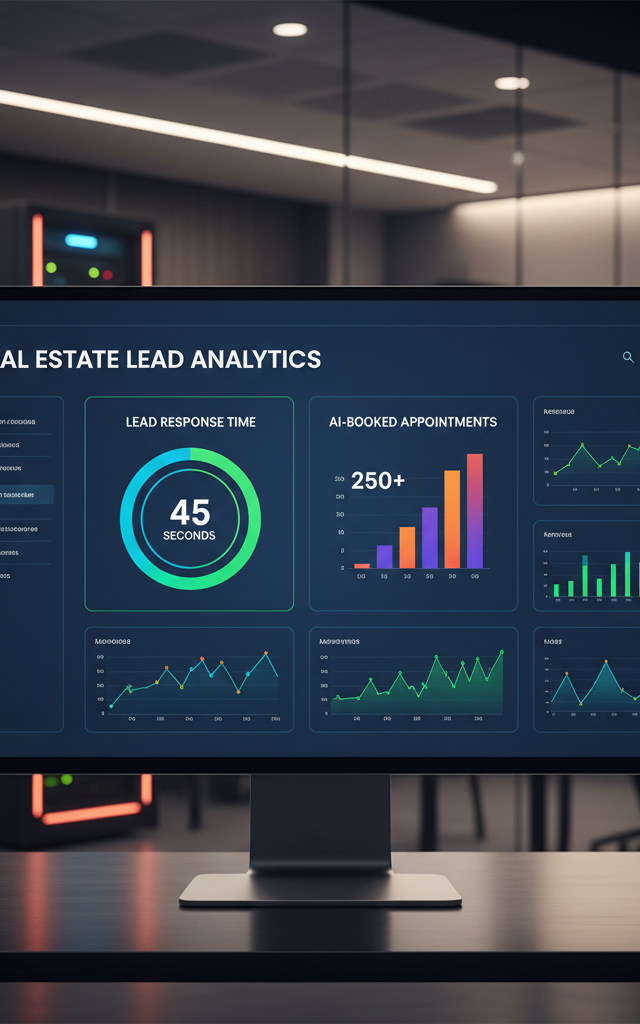
- Speed to Lead: AI systems respond to all inbound web leads via SMS in under two minutes, 24/7.
- Multi-Channel Follow-Up: The AI orchestrates conversations across SMS and email for persistent, non-intrusive nurturing.
- Dynamic Qualification: It asks intelligent questions to determine motivation, timeline, and agent representation before involving a human.
- Appointment Setting: Once a lead is qualified, the AI can access the agent's calendar and book a call or showing directly.
- Lead Revival: AI is used to re-engage old, cold leads from the CRM—often with surprising success—by reigniting conversations.
Can AI Replace Real Estate Cold Calling?
Yes, AI can effectively replace the manual, time-intensive act of cold calling. A real estate AI outbound calling system can dial thousands of numbers per day, navigate gatekeepers, and use a conversational voice to identify interested prospects, freeing the agent from hours of unproductive dialing.
The traditional model of an agent spending 4-5 hours a day smiling and dialing is broken and inefficient. For every 100 calls, an agent might have one or two meaningful conversations. An AI outbound caller flips this model on its head. The platform dials a list (e.g., FSBOs, Expireds, Circle Prospecting) and handles the entire initial interaction. It weathers the hang-ups, wrong numbers, and 'not interested' responses.
When the AI identifies a homeowner who expresses potential interest in selling or buying, its mission is complete. At this point, it can either schedule a follow-up call on the agent's calendar or perform a live transfer, connecting the agent directly to a warm, pre-vetted prospect. This transforms the agent's role from a low-success-rate prospector into a high-value closer who only engages with qualified opportunities. This is the primary driver behind claims of saving 80+ hours a week.
Benefits of AI Outbound Calling for Agents
- Massive Time Savings: Eliminates 15-20 hours of manual dialing per week, per agent.
- Increased Efficiency: The AI makes thousands of calls, filtering out rejections and connecting only interested parties.
- Improved Morale: Agents avoid the burnout and rejection associated with traditional cold calling.
- Consistent Performance: The AI never has a bad day; it performs its script perfectly every single time.
- Scalable Prospecting: Easily scale up or down calling campaigns without hiring additional staff.
What Are the Best AI Tools for Property Marketing?
The best AI tools for property marketing streamline content creation and visual presentation. These include AI copywriting assistants for listing descriptions and social media, AI-powered virtual staging software for vacant properties, and automated ad optimization platforms that target the right buyers on social media and Google.
For content, generative AI platforms can instantly produce compelling, SEO-friendly listing narratives. An agent simply inputs the property's key features (e.g., 4 bed, 3 bath, renovated kitchen with quartz countertops, large backyard), and the AI writes a beautiful, descriptive paragraph. This same technology can be used to create blog posts about the local market, social media updates, and video scripts, saving hours of creative work.
On the visual side, AI has revolutionized property presentation. AI virtual staging tools can take photos of an empty home and realistically furnish them in various styles within minutes, a task that used to cost hundreds of dollars and take days with a human designer. Other tools use AI to enhance property photos, improving lighting, color balance, and even replacing a grey sky with a beautiful blue one. These visual upgrades make listings more appealing online and can lead to more showing requests.
Types of AI Marketing Tools
| Tool Category | Primary Function | Agent Benefit |
|---|---|---|
| AI Copywriting | Generates listing descriptions, blog posts, social media captions. | Saves hours of writing time and overcomes writer's block. |
| AI Visual Enhancement | Virtual staging, photo editing, sky replacement. | Increases listing appeal and showing requests at low cost. |
| AI Ad Platforms | Optimizes ad targeting and bidding on Facebook/Google. | Improves return on ad spend (ROAS) and lead quality. |
How Does AI Help with Real Estate Market Analysis?
AI helps with real estate market analysis by processing enormous datasets—including MLS history, economic indicators, zoning changes, and demographic shifts—to generate highly accurate predictive pricing models and identify neighborhood trends much faster than a human could, empowering agents to provide superior advice.
A traditional Comparative Market Analysis (CMA) relies on a handful of recently sold comparable properties. While useful, this approach can miss subtle but powerful market undercurrents. An AI-powered analysis platform goes deeper. It can analyze thousands of data points in a given zip code to understand the true trajectory of property values. It can weigh factors like the proximity to new commercial developments, changes in school ratings, or shifts in rental demand.
For agents, this translates into a significant competitive advantage. When advising a seller, you can move beyond a simple CMA to provide a data-rich report that justifies a specific listing price with predictive analytics. For buyers, you can identify undervalued neighborhoods poised for growth. This positions the agent not just as a facilitator of a transaction, but as a deeply knowledgeable market advisor armed with institutional-grade data, building immense trust and credibility with clients.
Data Points AI Can Analyze for Market Reports
- Historical sales data from the MLS (price, days on market).
- Current inventory levels and absorption rates.
- Local economic data (unemployment rates, job growth).
- Demographic shifts (population growth, income changes).
- School district ratings and performance trends.
- Zoning changes and building permits issued.
- Sentiment analysis from online neighborhood forums.
Why We Are the Leading Real Estate AI Partner
Our expertise isn't theoretical; it's forged in the daily operations of top-producing real estate teams. As the exclusive AI partner for industry leaders like Douglas Elliman, we've moved beyond generic AI concepts to deploy real-world systems that deliver measurable results. Our primary focus is on building AI solutions that directly address the most significant challenges for agents: lead generation, lead conversion, and operational efficiency. We don't offer a generic chatbot; we provide a fully integrated real estate AI assistant trained specifically for the nuances of property transactions.
Our platform is the engine that enables agents to save 80+ hours of manual work, a figure derived from our work scaling teams who previously spent entire days on fruitless cold calling. By automating real estate AI outbound calling and lead nurturing, we transform an agent’s day from one of high-effort prospecting to one of high-value conversations. We understand the compliance landscape, the specific language that converts real estate leads, and how to seamlessly integrate with the CRMs agents already use. Our authority comes from a singular focus on the real estate vertical and a track record of empowering agents to close more deals by working smarter, not harder.
How Businesses Use Real Estate AI Today
- A brokerage in Miami uses an AI outbound caller to prospect expired listings, setting five qualified listing appointments per week automatically.
- A solo agent in Austin has their AI assistant instantly text every new Zillow lead, boosting their contact rate from 20% to over 75%.
- A team in New York uses AI to generate hyper-local market reports and blog content, establishing themselves as the go-to neighborhood experts.
- A West Coast luxury agent leverages AI-powered virtual staging to market multi-million dollar vacant homes, saving thousands on physical staging costs per listing.
- A growing team nurtures over 10,000 old leads in their CRM with an AI, generating two extra deals per month from their existing database.
- An agent uses an AI to instantly create compelling social media captions for their "Just Listed" and "Just Sold" posts, saving hours each week.
Frequently Asked Questions About How Real Estate Agents Use AI
Will AI take my job as a real estate agent?
No, AI will not replace agents. It will replace the tasks agents hate doing. AI is a tool to handle repetitive work like cold calling and initial follow-up, freeing you to focus on client relationships, negotiation, and closing deals, which require a human touch.
What is the first AI tool an agent should adopt?
The best first AI tool is an automated lead responder. The ability to instantly engage every new web lead via SMS 24/7 provides the most immediate and impactful return on investment by dramatically increasing your chances of converting expensive online leads into clients.
How much does a real estate AI assistant cost?
Costs vary, but most real estate AI platforms operate on a SaaS model with a monthly subscription. This fee is typically a fraction of the cost of hiring a human assistant or what you would spend on less effective lead generation methods, often ranging from a few hundred to a thousand dollars per month depending on scale.
What's the difference between AI and my CRM?
Your CRM is a database—a passive system for storing information. An AI is an active worker. The AI integrates with your CRM, pulls lead data from it, and actively engages those leads through conversations, then pushes the results and updated status back into the CRM.
Is AI difficult for real estate agents to learn?
No, modern AI tools for real estate are designed to be user-friendly with intuitive dashboards. The best platforms handle the complex technical aspects behind the scenes. Typically, setup involves connecting your CRM and defining basic rules, with the AI provider offering full support during onboarding.
Can AI write my real estate contracts?
No, AI should not be used for drafting legal documents like contracts. This task requires a licensed professional and strict adherence to local laws. AI is best used for top-of-funnel activities like marketing, lead generation, and communication, not for legally binding agreements or giving legal advice.
Related Articles


Ready to Transform Your Business?
Let's discuss how AI-powered automation can help you generate more leads and grow your business.
Book Your Free Strategy Call